
 Christina d'souza
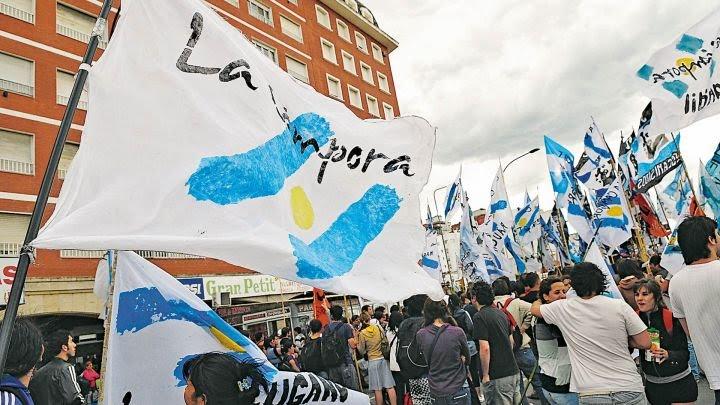
After rejecting in the Chamber of Deputies the project to endorse the agreement reached between the Government and the International Monetary Fund (IMF), the Kirchnerist group La Cámpora released a document in which it made an analysis of the current situation in the country and strongly criticized the international organization, the Minister of Economy, Martín Guzmán, and the debt contracted during the administration of former President Mauricio Macri.
At the end of the special session in which the payment facilities plan was discussed, the leader of this sector of the ruling party, Máximo Kirchner, went down to the floor together with some legislators from his space to vote against the initiative.
Shortly after, the text entitled “The IMF’s return to Argentina: How did we get here?”, in which La Cámpora explained some of the reasons why he differed from the rest of the ruling party and did not support this agreement.
The text begins by assuring that “when Néstor Kirchner decided to cancel the debt” with the Fund, he did not do so from an ideological perspective”, but from a “historical analysis, economic pragmatism and political conviction”.
In addition, the group considered that”From the irruption of the IMF in Argentina” and from “the application of its political-economic programs”, “an unprecedented cycle of indebtedness in foreign currency was unleashed in history that reached a scandalous turning point with the nationalization of the debt of the main concentrated Argentine business groups in 1982″.
Likewise, it maintained that the credit organization was the “star protagonist” of “the hyperinflationary crisis of 1989 that forced President Alfonsín to advance the elections” and that it also supported convertibility, “culminating with an institutional, economic, social and unprecedented policy.
“Five presidents in just one week marked with fire that stage that ended with the default; crisis in the financial system; unprecedented poverty rates; compatriots who lost their lives as a result of the repression of the security forces in the face of social protests”, he recalled.
In this sense, La Cámpora highlighted that the management of Néstor Kirchner “approached the negotiations with private creditors and the IMF from the most absolute political pragmatism”, in the framework “of the largest sovereign debt default in history that meant more of 150% of the GDP of Argentina”.
After recalling a speech given by the former national president when he cancelled the commitments with this entity, the group currently led by his son acknowledged that “in no way can that situation be compared with the current one,” but he assured that he can “describe what happens and what are the consequences whenever the Fund reaches the countries with its political-economic programs, its demands and its audits”.
“In short: of course, the situation is not the same; the one that does remain the same is the International Monetary Fund. Not conceiving it that way led to a wrong strategy being decided as of December 10, 2019, by the economic cabinet and the negotiating group headed by the Minister of Economy (Martín Guzmán), in their responsibility to renegotiate the unprecedented debt contracted by the government of Mauricio Macri for 57,000 million dollars, of which 44,500 million dollars were disbursed in just one year, “said La Cámpora.
Likewise, the group defended the presidencies of Néstor and Cristina Kirchner by arguing, among other points, that “the doubling of the middle class (reported by the World Bank in 2012) constituted the undoubted testimony of the upward social mobility that characterized that decade.”
On the contrary, he questioned Macri’s management by pointing out that “the government that began on December 10, 2015, launched an unprecedented process of taking on foreign currency debt, due to the speed and magnitude of the amounts, which led to being in the years 2016 and 2017 the country that borrowed the most in the world.
“This unprecedented process of public indebtedness was contemporaneous with a reduction in capital spending by the national public sector in real terms, so it was basically short-term portfolio investment for speculative purposes in the context of high interest rates. interest established by the BCRA and the National Treasury for the issuance of their letters and titles, and the financial deregulation and the movement of capital. This procedure is known as carry-trade or, in popular Argentine jargon, as the already legendary and autochthonous financial bicycle”, he insisted.
At this point, La Cámpora criticized the IMF loan, stressing that “it was the largest program in the organization’s history” and “it was even superior to the financial bailouts in the context of the crisis” of 2001.
“The irregularities of this credit were not only due to the excess of the quota that determines the maximum amount of financing that the country can obtain from the IMF (around 18,000 million dollars), but also to the fact that this credit was used to finance a capital flight. abroad,” said the group.
In this sense, a recent article was mentioned that ensures that “the 2018 stand -by agreement violated the fundamental purposes of the IMF according to its constitutive agreement, which would constitute an ultra vires act and, therefore, would be invalid and null”.
“The Argentine government should have opted for a ‘tough’ negotiation that seeks to extend the repayment terms above the regulations in force in the IMF, eliminate the interest surcharge and expose before the Argentine men and women and before all possible International Forums, not only those very serious irregularities of the loan granted to Mauricio Macri but also the strictly political nature and objective of said loan and that it was externalized by an official of the Trump administration and current President of the IDB: to come to the aid of the Cambiemos government and save the administration of Mauricio Macri”, he added.
For La Cámpora, however, the economic team led by Guzmán “developed a strategy of ‘kindness’, secrecy, secrecy, confusion and misinformation in the negotiations, which can only be explained by the widespread belief that we were facing a ‘new’ International Monetary Fund that he would be seduced by the academic expertise and the ‘good manners’ of the Argentine negotiators and interlocutors”.
Finally, this sector strongly questioned the agreement reached by the Government with the international organization, stating that although it says that its objective “is to achieve macroeconomic stability, in fact, the country is exposed to a scenario of default every three months”.
In this regard, the group that responds to Máximo Kirchner lamented the “degree of interference in the administration of public affairs that the IMF will effectively have” and the fact that the negotiations have not ensured “the sustainability of indebtedness after 2025, a moment in which, once the grace period has expired, the repayment stage begins”.
“In this context, with a new government, it is likely that Argentina will have to restart talks to review the sustainability of its debt. Being necessary to resolve longer terms with the agency itself or alternative strategies, such as changing the financier. It is worth noting that in the files sent to the National Congress there is no mention of the repayment or return structure of this ‘new agreement’, which is unusual in this type of instance”, it was warned.


GIPHY App Key not set. Please check settings