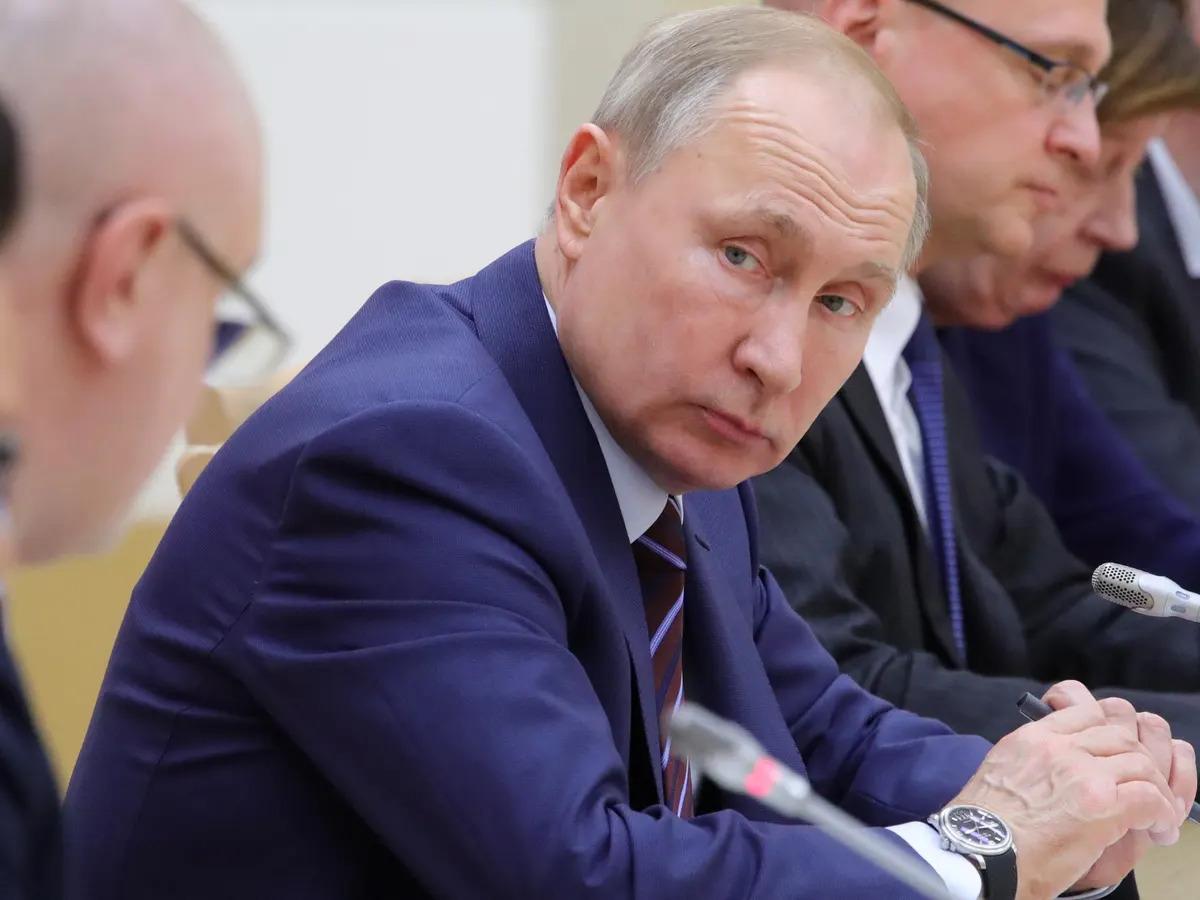
Putins plans
During the second day of the war, the invading troops have tightened their siege on the country’s capital, Kiev, and Vladimir Putin has shown himself willing to start a dialogue with the Ukrainian president, Volodymyr Zelensky, despite accusing him of barricading his soldiers after civilians to later accuse Russia of war crimes.
“In response to the Ukrainian president’s request,” Kremlin spokesman Dimitri Peskov said, “we are ready to send representatives of the Foreign Ministry and the Presidency for negotiations.”
But the negotiations that Russia is talking about, which would require the prior laying down of arms by the Ukrainian army, are nothing more than an unconditional surrender. The Russian president thus intended to transfer all the pressure to the Ukrainian government, which has responded by offering not to enter NATO. That is, to maintain its neutral status, one of Putin’s demands prior to the invasion.
Beyond the information, impossible to confirm, that speak of a Ukrainian resistance greater than what Russia expected, there is the reality of the facts. And the facts are that the Russian troops have barely taken 24 hours to reach Kiev and that their special forces, the Spetsnaz, are already, according to several sources, in the suburbs of the capital.
Other information speaks of the deployment of Chechen special forces under the orders of Ramzán Ajmátovich Kadýrov, head of the Chechen Republic, with orders to “hunt” the Ukrainian leaders included in a deck of cards like the one that American soldiers handled during the war of Iraq in 2003 to help them identify the most wanted figures in Saddam Hussein‘s regime.
The thesis that we talked about in this Friday’s editorial and that speaks of a fall of Kiev in just two or three days, perhaps during this same weekend, seems closer to being fulfilled today than yesterday. If that happens, it would be absurd for Europe and NATO to entrust everything to an eternal guerrilla war that would wear down Putin and his army, yes, but that would also devastate the country and cost the blood of thousands of Ukrainians.
No one knows for sure what Putin’s real goals are with this war, but one thing seems clear, both from the scale of the invasion and its intensity. Those goals go beyond, far beyond, Ukraine.
Proof of this is the threat from the spokeswoman for the Russian Foreign Ministry, Maria Zaharova , who warned this Friday that the accession of Finland and Sweden to NATO would have “political-military consequences.”
A threat to which the Spanish Foreign Minister, José Manuel Albares, has responded by saying that the entry of both countries into NATO is “something that we would have to discuss. Nobody should tell us who should be a member or not.”
The West has so far shown rocky unity in condemning the invasion of Ukraine and the need to impose heavy sanctions on the Russian regime. But also a striking division when specifying the harshness of these sanctions, with the expulsion of Russia from the SWIFT system at the center of the debate.
As much as the supposed parallels of the Russian invasion of Ukraine (the Sudetenland, the Munich Agreement, Adolf Hitler, the Russian invasion of Prague and Budapest) emerge in the journalistic chronicles, the truth is that there are no historical precedents or instruction manual for what is happening in Eastern Europe.
What is the true degree of China’s support for the invasion of Ukraine? Will Putin settle for control of Ukraine’s eastern provinces or does he aspire to total control of the country? Does Putin intend to redefine the balance of power and the status quo in Eastern Europe? To divide the countries of the European Union and gradually undermine the credibility of NATO?
It is likely that only Putin and a small circle of faithful around him know the true intentions of the Russian president. But the West must now consider the scenario after the end of the war. The sanctions will weaken the Russian economy, but they will also accelerate the creation of an alternative economic axis around China, whose objective is to end the consideration of the dollar as the world reference currency.
Hopefully the EU, US and NATO are more diligent in designing the post-invasion scenario than they have been in helping Ukraine prepare for an attack. Since they have not been able to prevent aggression (and have not wanted to get involved in the conflict with troops on the ground), let them at least avoid the serious consequences for liberal democracy that it will have in the future.
Creating a completely different series based on a universe that knows half the world can't… Read More
The strikes of scriptwriters and actors have put in check the constant flow of content to… Read More
Money Heist has returned to Netflix. This time as a prequel to the original series… Read More
One of the 50 best war films in cinema history turns 25 years old. And it is not… Read More
What is the singapore kiss In short, it is about emulating during intercourse, through the… Read More
Regarding patents, Sony is one of the technology companies that has carried out the most registrations in… Read More
