In the first appointment, the surgeon will examine you and advise you according to your needs. He will explain how the procedure is performed, the benefits of removing Bichat balls, and the possible disadvantages and risks.
During this first consultation, do not hesitate to ask your surgeon about all your questions, share your doubts and ask to see the photos of other patients who have undergone the procedure. Some surgeons may also show you a simulation of the result.
How is the intervention carried out?
The procedure is done on an outpatient basis and takes about 45 minutes. With regard to anaesthesia, some surgeons prefer it to be general for the patient’s comfort, and others prefer local anaesthesia. Do not hesitate to talk to your surgeon, and he will suggest the solution that best suits your needs and your case.
The procedure itself is pretty simple. The surgeon makes an incision inside the mouth of 15 to 20 millimetres and removes a part of the Bichat balls. Next, you will put one or two absorbable stitches. As the incision is made inside the mouth, no scar will be visible, and the results will be very natural.
How is the postoperative?
The postoperative period of a bichectomy is not painful, but it can be somewhat uncomfortable when eating. During the first days after the procedure (up to a week), edema or swelling will appear around the cheek area, similar to that of an operation to remove wisdom teeth. Some surgeons apply a bandage, but it is not required. It is recommended to apply ice to the inflamed area to reduce inflammation and sleep with your head elevated with a couple of pillows.
An antibiotic should always be prescribed for about seven days and anti-inflammatory drugs to reduce possible post-surgical discomfort after surgery. It is very important to warn the patient that they must maintain correct oral hygiene and avoid tobacco since it favours infection. That is why it will be necessary to perform regular mouthwashes.
As for meals, liquid or mixed foods are recommended during the first week. You can return to work as soon as possible as the swelling has subsided.
After 10-15 days, the suture will fall out on its own, and since the incision is made inside the mouth, no scar will be visible. You can resume sports activities from the second week.
As for the final results, they will be really visible after three months, and unlike other treatments aimed at removing fat, they are permanent.
How is the postoperative?
The postoperative period of a bichectomy is not painful, but it can be somewhat uncomfortable when eating. During the first days after the procedure (up to a week), edema or swelling will appear around the cheek area, similar to that of an operation to remove wisdom teeth. Some surgeons apply a bandage, but it is not required. It is recommended to apply ice to the inflamed area to reduce inflammation and sleep with your head elevated with a couple of pillows.
An antibiotic should always be prescribed for about seven days and anti-inflammatory drugs to reduce possible post-surgical discomfort after surgery. It is very important to warn the patient that they must maintain correct oral hygiene and avoid tobacco since it favours infection. That is why it will be necessary to perform regular mouthwashes.
As for meals, liquid or mixed foods are recommended during the first week. You can return to work as soon as possible as the swelling has subsided.
After 10-15 days, the suture will fall out on its own, and since the incision is made inside the mouth, no scar will be visible. You can resume sports activities from the second week.
As for the final results, they will be really visible after three months, and unlike other treatments aimed at removing fat, they are permanent.
The results
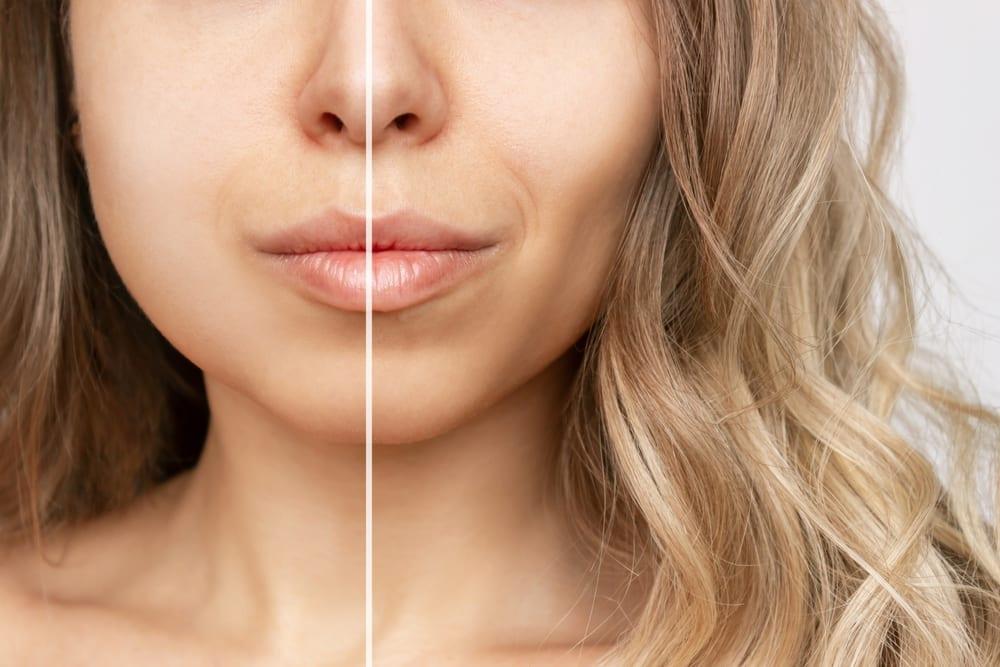
With the bichectomy, the face is refined and lengthened. Since with the Bichat balls’ extraction, the cheeks’ roundness is eliminated, and the cheekbones are highlighted. On the other hand, being a minimally invasive technique, the results are natural and recovery times very fast.
It must be taken into account that once the fat has been extracted, it is impossible to reposition it again. Yes, there are techniques such as lipofilling, which with the patient’s fat allows increasing the volume of the face.
Complications or possible side effects
Although the risks are rare, complications may appear. As with any intervention, the main risks are related to infection or bleeding.
This intervention must be performed in an accredited center and by a specialist surgeon, accustomed to handling the oral cavity and with perfect knowledge of facial anatomy since it can cause lesions in the canal if in inappropriate hands that conducts saliva from the parotid gland to the mouth, or lesions in some of the branches of the facial nerve.
Frequently asked questions
- What type of anaesthesia is applied? Bichectomia is performed on an outpatient basis and under local anaesthesia. In some cases, it can be done with mild sedation.
- What techniques exist to extract the Bichat balls? These fatty deposits are surgically removed from inside the mouth, without visible scars, through an incision at the level of the upper molars, exposing the ball of Bichat and carefully dissecting it until it is almost completely extracted. It is sutured with absorbable thread, so there is no need to remove the stitches.
- Is there a risk of premature ageing? There is no scientific evidence to support the claim that removing the fat balls from the Bichat the skin remains bad, sagging, or sagging. It does happen that with age, the skin of the entire body becomes more flaccid (whether you have a Bichectomy or not), and in the case of women with menopause, it worsens a little more. In any case, there are current techniques that allow you to slim the ball of Bichat without removing it completely, since there are some people who have skinny faces, and removing it completely could leave them even thinner.
- What are Bichat balls? Bichat balls are fat deposits found in the region of the cheekbones or malar bones. This fat, being vascularized, increases with weight gain.
- When can we see the results? It is normal, after the intervention, that there is an inflammatory process for about two weeks. Generally, the results begin to be noticed a month after the surgery, and it is definitive at three months.