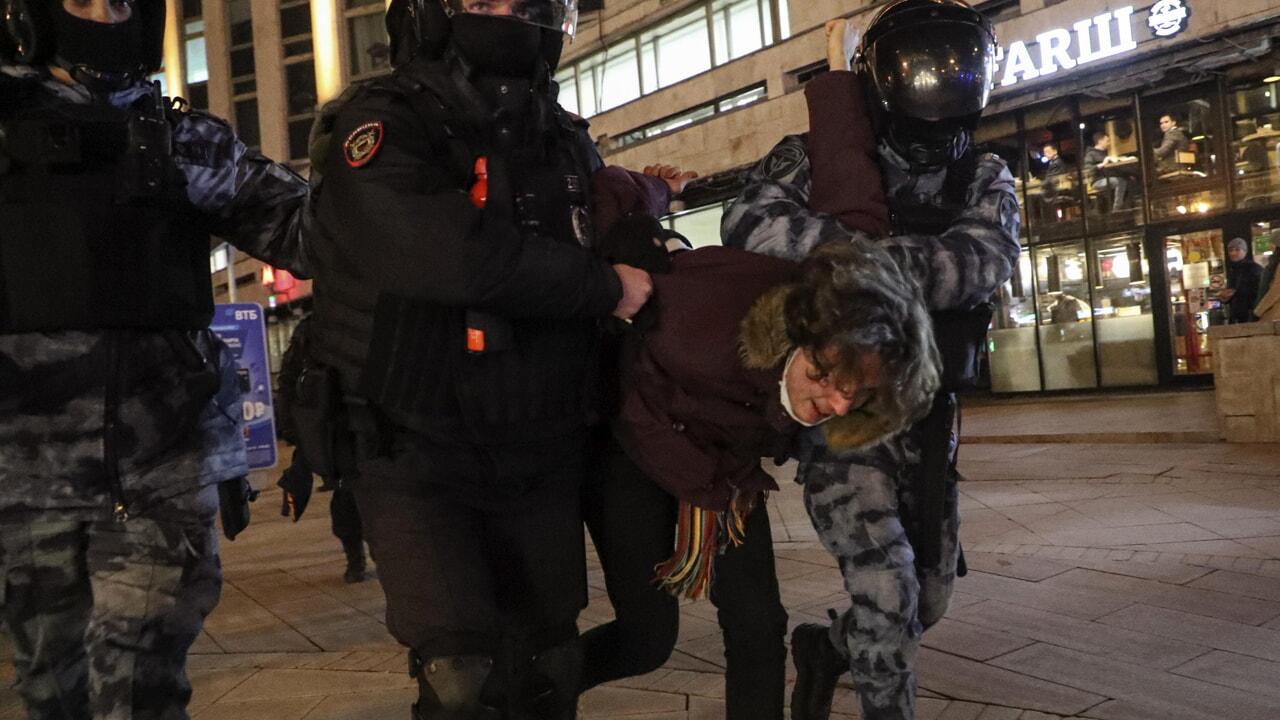
Arrests in Moscow photo Ansa
Not only rockets and bullets but also propaganda and information control. They have always been among the key weapons in conflicts. The war being fought between Russia and Ukraine is no exception. The media, even more, today, have a central role. This is demonstrated – and these are only two recent examples – by the bill that will be discussed by the Russian Parliament which provides for the possibility of up to 15 years in prison for those who publish false information on the army, but also the fact that the European Commission has banned Russian state TV RT and online newspaper Sputnik as “information manipulators of the Kremlin”. To see how different the narration of events is on both sides, just scroll through the “history” of Russian TV and newspapers.
Before Putin’s speech to the country, Russian television did not spend time on the Ukrainian question, focusing more on the Winter Olympics. When the topic is introduced, there is talk of military escalation wanted by the West and the (alleged) Ukrainian aggressions in Donbas. For media around the world, the conflict begins with the Russian bombing of Ukraine and the subsequent land invasion. In Russia, this is reported as a “special military operation” to stop Ukrainians’ violence and attacks on the Russian population. The main channels such as Pervyj Kanal and Rossiya 1, both controlled by the state, speak of a demilitarization operation aimed at military infrastructures to defend the Donbas people’s republics recognized by Putin. The version, in short,
The very presence of civilian victims is reduced and in any case, attributed to the counterpart. The responsibility lies not with the Russians, but with the “Ukrainian nationalists”. Independent newspapers are silenced, in whole or in part. The Russian federal service that controls communication in the country is clear when it says: “Russian official sources have accurate and up-to-date information.”
Looking for “other” sources, trying to hear “the other bell” is the basis of journalism, it is the first rule to convey a non-partisan message: “The government is ordering us not to use the words war, invasion and civilian casualties”, reveals the director of one of the 11 Russian news outlets blacklisted and monitored by the government.
While TVs around the world relaunch images of Ukrainian refugees, Russian TVs talk about how the Kiev militias carry out “acts of provocation against Russian civilians and forces” and speak of “civilians as human shields, deliberately positioning systems of attack in residential areas and intensifying the bombing of the cities of Donbas “.
And the propaganda goes straight to the schools. The Russian government is releasing a video lasting several minutes to explain to children, through a cartoon, what is happening between Russia and Ukraine. Two friends – one wearing a sweater in the colors of Ukraine and the other with those of Russia – are turned away by “bullies”. Jersey? Like the USA flag …
The lifting of TV presenter Ivan Urgant from office and the decision to exclude the respected journalist Elena Chernenko from the pool of reporters following the government lectures, just for writing an anti-war letter, well illustrate the Russian authorities’ contempt for the freedom of the press. While Russia carries out indiscriminate attacks in Ukraine, in violation of international humanitarian law, the Moscow authorities are crushing the rights to freedom of expression and peaceful demonstration by imposing their own narrative of the conflict. The brutal repression against those who express dissent against the war must be stopped ”. While Russia carries out indiscriminate attacks in Ukraine, in violation of international humanitarian law, the Moscow authorities are crushing the rights to freedom of expression and peaceful demonstration by imposing their own narrative of the conflict. The brutal repression against those who express dissent against the war must be stopped ”. While Russia carries out indiscriminate attacks in Ukraine, in violation of international humanitarian law, the Moscow authorities are crushing the rights to freedom of expression and peaceful demonstration by imposing their own narrative of the conflict. The brutal repression against those who express dissent against the war must be stopped ”.
The United States today accuses the Kremlin of launching a “total assault on media freedom and truth” and denounces – in a statement by the State Department spokesman, Ned Price, referring to the cases of Moscow’s Echo radio and Dozhd TV – how “Moscow’s efforts are intensifying to mislead and repress the truth of the brutal invasion”. The US State Department denounces that the Russian government is also “stifling the Twitter, Facebook and Instagram platforms on which tens of millions of Russia’s citizens rely for independent information and opinion and to connect with each other and with the outside world.” According to Price, the Russian parliament will meet tomorrow to consider legislation that would make ‘unofficial’ reports on the crime a crime. Russian invasion of Ukraine. “The people of Russia did not choose this war – the statement continues – They have the right to know about the death, suffering and destruction inflicted by your government on the people of Ukraine. They also have the right to know about the human costs of this war. meaningless to their soldiers. ”
This post was last modified on April 6, 2022 3:07 pm
The John Wick series has established itself as one of the few major action series today that… Read More
After binge-watching Shadow and Bone season 2, many viewers have been left with a million… Read More
The thought of Thor coming down from the heavens and saving us from catastrophes is… Read More
The action movie industry has been dominated by superhero franchises such as Marvel and DC… Read More
You might be disappointed when you watch Tiller Russell's latest documentary series, Waco: American Apocalypse,… Read More
The Pope’s Exorcist is a horror movie released in 2023 that’s based on the life… Read More
