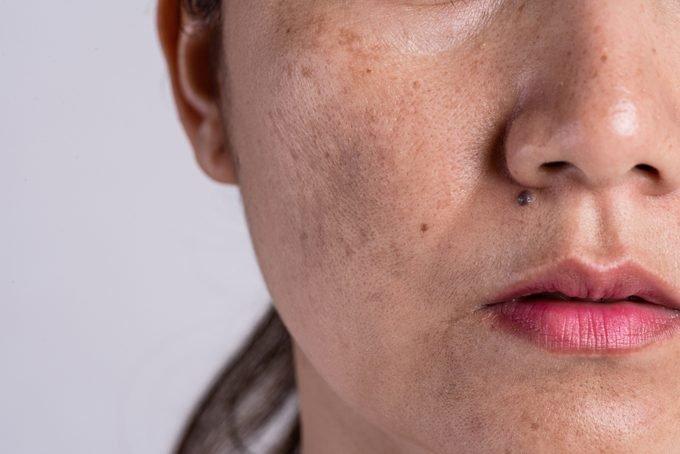
Skin hyperpigmentation is due to an excess of melanin, the pigment that gives natural color to the skin, hair and eyes; when it appears in visible areas, such as the face, it can become an aesthetic problem that is difficult to eliminate; specifically, the dark color on the upper lip creates a shadow reminiscent of a freshly shaved male mustache, with an unpleasant aesthetic effect.
During our life we can develop various skin conditions . One of the most common is skin hyperpigmentation . Along these lines, it is important to note that there are various types of stains due to the excess or lack of some types of pigments. When a stain occurs due to excess pigmentation or the absence of this caused by an increase or deficit of melatonin , they are called melanic dyschronias.
Why are skin blemishes generated?
Skin spots can be caused by various factors, among which we can highlight:
- An increase in melatonin due to melantoncytes , cells that are responsible for generating its synthesis. This is known as skin hyperpigmentation .
- Due to increased reproduction of melantoncytes .
- Excessive exposure to the sun or ultraviolet light.
- In this sense, different types of spots may appear, among which they can be classified as follows:
- Lentigines: they can be brown, almost black spots and in most cases appear in areas exposed to the sun. One stain or several may appear.
- Simple lentigo: These spots can appear anywhere on the body, they are dark or brown and are not related to sun exposure.
- Peutz-Jeghers syndrome : These spots are of a more dangerous nature and can appear on the lips , oral mucosa, feet or fingers . In some cases, these spots may be accompanied by gastrointestinal polyps, which must be diagnosed and treated with special care, since they can often bring serious associated health problems such as anemia or the malignancy of some of these spots.
- Ephelides or freckles : they are caused by increased melanin production by melantoncytes. They generally do not have any consequences for our health. They measure 0.5 cm and usually have well-defined edges. They appear after prolonged exposure to ultraviolet rays.
- Melasma: has poorly defined and fuzzy edges. Most are milky brown or light brown in color . They usually appear in specific areas of the body, such as the forehead, cheekbones, upper lip, etc. It is much more common in women than in men, but it does not carry any associated health risk, only an aesthetic one.
- Addison’s disease : it is characterized by being a disease that denotes by an insufficiency in the adrenal gland. It appears as generalized brown spots. People with it feel nauseous, fatigued, vomit, and have diarrhea . The spots commonly appear around the eyes, mouth, gengivas , among others.
The hyperpigmentation may be symptomatic of some diseases, autoimmune and gastrointestinal diseases, and metabolic disorders and vitamin deficiency; It may be due to the side effects of some hormonal treatments, chemotherapy, antibiotics, or, as in the case of the “mask of pregnancy” (chloasma), progesterone and estrogens.
Once confirmed that it is not due to a disease, we must think about aesthetics, looking for how we can eliminate the dark area that forms on the upper lip.
Treatments to remove stains
- The chemical peel, carried out in a specialized center, is an effective response to contrast hyperpigmentation and achieve a new, uniformly colored skin. It consists of the application of various types of acid solutions that remove the superficial layers of the skin. If it is allowed to act in depth, the peeling can cause a real programmed burn of the skin, achieving deep exfoliation and regeneration.
- Also laser therapy and pulsed light have a similar effect, but more precise and careful, with the doctor in charge of modifying the intensity and, therefore, the effects. The rays that come out of the laser and IPL affect only the subcutaneous pigments, breaking them, so that they are absorbed naturally by the body, without damaging the surrounding tissues.
- Pharmacology has a wide range of products that guarantee the reduction of the dark area in the area of the “mustache”, most of which act on the production of melanin, in order to prevent the formation of new dark areas and attenuate the already existing; the Dermamelan , for example, is based on the inhibition of tyrosinase, melanogenesis responsible enzyme.
- Substances such as hydroquinone and arbutin have been used for many years to treat this pathology, but their use entailed some complications and side effects; Derivatives of Vitamin C, in combination with other active ingredients, have proven to be effective against this stain, as well as derivatives of retinoic acid, azelaic acid and resorcinol. These drugs are given under strict medical supervision, because they can irritate the skin and make it more sensitive to the sun, making the situation worse.
Even treatments like dermabrasion, laser, pulsed light, and chemical peels can have side effects, leading to new post-inflammatory hyperpigmentation, especially in people with dark skin.
We recommend taking the greatest possible care when choosing therapy, avoiding “do it yourself”, selecting only specialized doctors, capable of identifying the best therapy to solve each specific case.
How to avoid skin blemishes
Although there are many treatments to avoid spots on the skin, it is best to prevent them or if we have already done some type of treatment to reduce or eliminate them and we want the result to last over time, we recommend:
- Avoid sun exposure: it is best to always carry a day moisturizer with sunscreen.
- If you go outside and you will be walking for several minutes, even if the day is somewhat cloudy, we recommend you wear a hat and glasses to protect the most sensitive areas such as the eyes, nose and forehead.
- Keep the skin hydrated and drink lots of water. At least 8 glasses of water a day.